The Borough of East Greenville was incorporated in 1875 in the Goshenhoppen region of Upper Montgomery County. In 1875, the extension of the Perkiomen Railroad through the borough helped to stimulate the growth of the borough, along with the Green Lane and Goshenhoppen Turnpike. The population of the borough was 200. The borough got its name from large evergreen trees in the northern part of the borough. Originally, the name Greenville was proposed, but when the borough proposed establishing a post office, it was learned that Greenville existed in western Pennsylvania. So the name became East Greenville.
The territory to form the borough was taken from Upper Hanover Township, for an area of about 0.61 square miles. The borough had about fifty homes, eight stores, and businesses that included two cigar manufacturing factories.
The first post office was located at Fourth and Main Streets. Other locations were 316 Main Street, 258 Main Street in Realty Hall, and then back to Fourth and Main Streets to its present location.
Water service was developed in 1894 when the residents requested a municipal water supply. The borough approved a loan for $16,000.00 to erect a waterworks plant along the Perkiomen Creek at Fruitville Road and Water Street. Water mains were laid into town, and a 100-foot-tall standpipe was erected at 435 Main Street. This original waterworks building still stands at that location and is used for the storage of parts and equipment. In 1938, a new water plant was built adjacent to the original plant. A 300,000-gallon water storage tank was erected next to the old standpipe. The primary water source remains the Perkiomen Creek, but in 1959, a well was dug next to the water plant to augment the water supply. In 1989, the borough began a major renovation of the water treatment plant to meet the required quality standards. During 1998, the original standpipe was determined to be obsolete and was removed. Plans were started in 2003 for the upgrade of the water system including remedial work at the treatment plant, the construction of a new water impoundment dam on the Perkiomen Creek, the erection of a new 750,000 gallon water tank, replacement of older water mains and service lines, the construction of a new maintenance garage, and the demolition of the 1938 water tank. Drinking water is still pumped from the 1938 water treatment plant and is supplemented by the well from 1959. The average daily demand is around 200,000 gallons per day.
The fire company was formed in 1895 with the purchase of a hose cart used to fight fires. The fire company was not chartered until May 25, 1900. The first fire station was located in a two-story brick building at 435 Main Street, which remains owned by the borough and used for the storage of municipal equipment. The second floor of the building was used as a meeting room. The borough council met on the second floor of the building until 1957. In 1924, the fire company purchased a motorized truck from the Stutz Motor Company to replace the manually drawn hose carts. With the purchase of the motorized pumper, the fire company moved to new quarters at Fourth and Main Streets. In 1949 and 1951, the fire company purchased two Mack pumpers. Shortly thereafter, the fire company determined larger quarters were needed and purchased a tract of land at the present site, Fourth and Washington Streets. A four-bay station, with a banquet hall, six bowling alleys, a grill room, and two meeting rooms, was built in 1957. Upon the completion of this building, the borough council moved its chambers to the second-floor meeting room. In 1975, the fire company added a new pumper, and again in 1980. Additional pumpers were purchased in 1988 and 1993, along with the purchase of a medium-duty rescue truck in 1986. In 1998, the fire company purchased a ladder truck from the Hatfield Fire Company to meet the needs of the growing area. The fire company remains at 4th & Washington Streets and remains a volunteer fire company with a 2013 Spartan ladder truck, and a 2009 Spartan Rosenbauer pumper.
In 1853, the Greenville Academy was established in a house near Fourth and Main Streets as a private school. The Greenville Literary Society was founded in 1872. A school building was erected on Third Street just west of Main Street. This building has since been demolished. The Third Street school was expanded several times because of increased enrollment. A new building was erected at Fifth and Jefferson Streets in 1914, making additional high school classes possible. After several expansions, the original building was demolished. The East Greenville Public Schools became part of the Upper Perkiomen School District in 1952. The school complex is currently used as a 4th & 5th-grade school.
Also in 1952, the St. Philip Catholic School was established at Sixth and Main Streets. This school enrolled students from preschool through the eighth grade. St. Philip School closed and is now a commercial use.
Throughout the years, there have been several churches that have been built in the borough. The first church was the Grace Evangelical United Brethren Church located at 206 Main Street. The building underwent a major renovation in the mid-1950s, and the congregation disbanded in 1970 due to decreased enrollment. The building was taken over by the Upper Perkiomen Bible Church for some time. The building currently houses borough hall.
Ebenezer Evangelical Congregational Church was constructed in 1895 in the 100 block of Main Street. The original building was demolished in 1930 and replaced by the current structure. The church was occupied by the Peace Mennonite Fellowship and is now Bike & Soul.
Roman Catholic services were held in the St. Philip Neri located at Sixth and Main Streets from 1911 to 1970, when a new church was built in Upper Hanover Township. The property is now used for a commercial purpose.
In 1894, St. John’s Chapel was built in the 300 block of Jefferson Street by the New Goshenhoppen German Reformed United Church of Christ for auxiliary worship. This building suffered a fire in 1979 and was vacant most of the time until 1996, when the building was demolished.
In 1964, the Lighthouse Tabernacle of the Assembly of God was built in the 500 block of Jefferson Street. Due to considerable growth, the building was sold to Montgomery County for use as the Upper Perkiomen Senior Center, and the congregation moved into a new building in Upper Hanover Township in 1980. The building is used by Open Link and remains a Senior center along with other community service uses.
There were several various businesses in the borough during the 1890’s including carriage building, sign painting, sale of stoves and phonographs, shoemakers, and blacksmiths. A bakery existed for many years until a metal plating business bought the building, which is currently located at 248 Main Street. Other businesses include the Bauman Cleaners, currently the Bitterman’s Comic Book Store, the Home City Ice plant on Washington Street, Schell Memorials, Perkiomen Printing, The Bus Depot, Holiday Hair Fashions, Mann Funeral Home, among others. Other businesses were prominent in the borough throughout the years. These included lumber and coal yards, silk weaving, burial casket manufacturing, knitting mills, furniture making, movie theaters, etc. The East Greenville plant of the Boyertown Burial Casket Company was located along the railroad tracks from the early 1900s until 1945, when the plant was closed and all manufacturing was moved back to Boyertown, PA. The building was then occupied by S.O.S. Products. The building was renovated into 71 apartments and is owned by The Willows. The Sanitary Company of America made cast-iron pipe and fittings from 1918 to 1959 in the foundry property on State Street along the railroad tracks. The business employed 250 people until bankruptcy. The property is currently used by Custom Processing Services.
Cigar making was a prominent business for many years. In 1890, the Eisenlohr Brothers opened a factory on Fourth Street along the railroad, becoming the borough’s largest business at the time with 325 employees. The cigar manufacturing business ended in the building in the 1930s. The building was then occupied by the Tremblau Silk Company until 1944. Then Knoll Industries purchased the building for furniture manufacturing. When the company built a new facility in Upper Hanover Township, the building was used for storage. The building was purchased by the borough in 1996 and torn down.
The railroad was operated by the Reading Company until 1976. At its peak, eight passenger trains ran daily: four in each direction. Freight trains shipped raw materials and supplies, and finished products were shipped out. The railroad built a station at the tracks on Fourth Street. The original station was destroyed by fire, and the current building, now a residence, was built. The last passenger train ran in 1955. The railroad is now owned and operated by the Eastern Penn Railroad as a freight-only railroad.
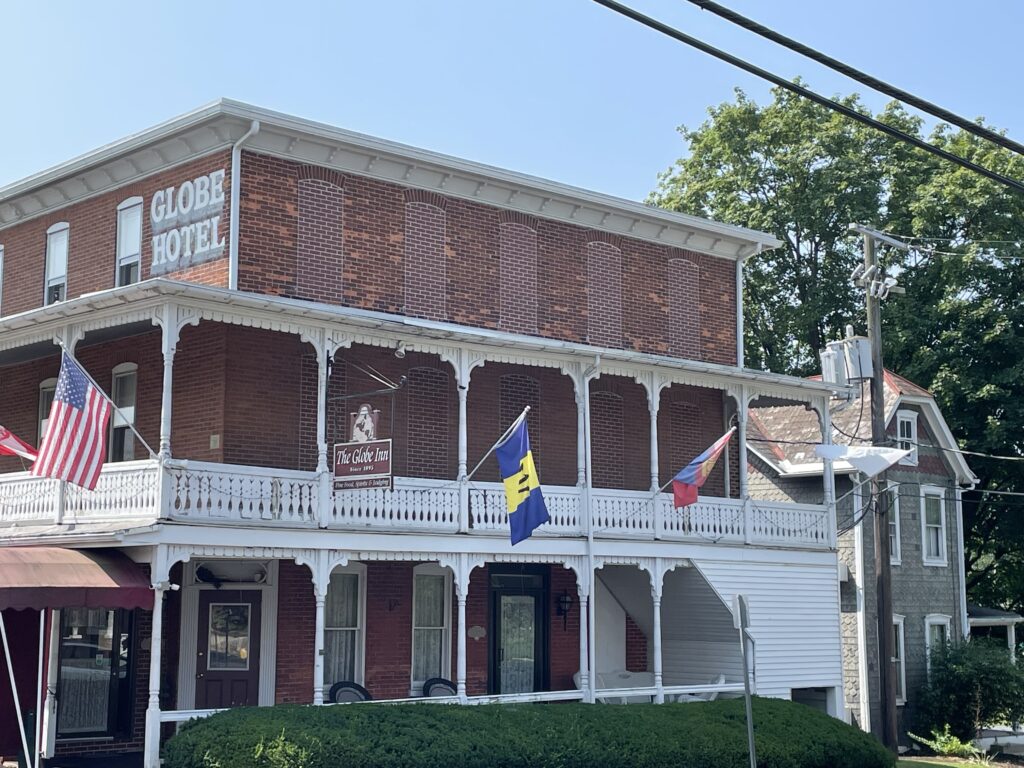
Two hotels exist in the borough. The Owl’s Home, located at Bank and Main Streets, originally had many owners, such as the Keely House, the Kockel House, and the Barbey’s Beer Company. The building had a bandstand in front for outdoor band concerts. The Globe Hotel was built around the time of the railroad construction for rail travelers. The Globe continues to operate a restaurant and rent rooms on the upper floors.
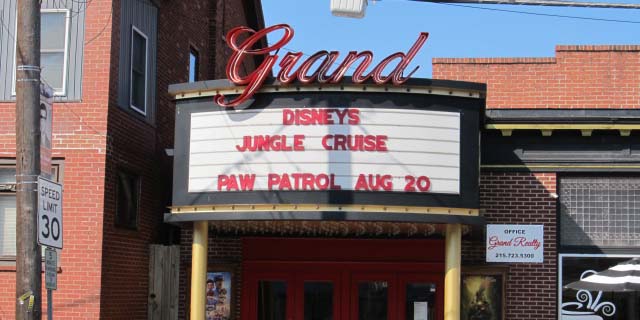
Originally, two theaters were located in the borough. The Palace Theater was built in 1910 on Fourth Street near the Globe Hotel. Offering motion pictures and live shows, the business had little success. The building was constructed entirely of wood and was deemed a fire hazard. The building was torn down in 1936. The Grand Theater was built at 252 Main Street. The theater showed silent movies, vaudeville acts, and later, first-run movies. The theater has been remodeled and is open for movies.
The New Goshenhoppen Park on Third Street is owned by the New Goshenhoppen Church. The six-acre site is used for outdoor picnics, community events, band concerts in the band shell, and dinners in the dining hall. The park had long been the site of the popular Goshenhoppen Folk Festival every August. The park is still owned by the New Goshenhoppen Church.
Baseball was played in the borough for many years on the former field located at the current site of the shopping center at East 4th Street and Washington Street. The field had a seating capacity of 1,200 as the borough’s team was a member of the East Penn Semiprofessional League until 1950, when a storm destroyed the stands at the ballpark. Semiprofessional football was played on the field for several years during the 1930s. Basketball was played on the second floor of Realty Hall at Third and Main Streets. Both the high school and a semiprofessional team used the court in the building.
The borough remains at 0.61 square miles and has a population of approximately 3,166. There is little open space to build in the borough without revitalizing and redeveloping existing properties. During 2004, a program was begun to revitalize Main Street, beginning between Third Street and Bank Street. The borough is currently served by PECO Energy for gas, PPL for electricity, Verizon for telephone, Comcast for cable television, and Upper Montgomery Joint Authority for sewer. The borough provides public water service.
